Average Amount Family Spends on Meat Each Year
Co-ordinate to data from the Part of National Statistics, the average UK household spends £three,312 on groceries and £1,716 on restaurants and takeaways every yr. As a result, in 2019 Uk households spent 16% of their budgets on food and non-alcoholic drinks. Some other 3% of budgets went to alcohol, which you lot can read more about in our related article Boilerplate Spending on Alcohol in the Britain.
In this written report nosotros'll prove the breakup of household home nutrient budgets per calendar week and per month across food categories, typical amounts spent eating out and finally how food & drink budgets change with income levels and family sizes. Food prices in the Uk rose again last twelvemonth, making this an of import budget category.
Delight note that these figures reflect average amounts actually spent according to the ONS survey, they are not recommendations well-nigh how much you should spend. Food spending varies a LOT from ane household to another based on factors like income, size and makeup of the household, the food you buy and other factors. Yous tin can get a sense of this by viewing the poll results further down in the commodity.
- Food prices are rising, but past how much?
- How much do households spend on food?
- Boilerplate weekly food bill
- NEW POLL: How much practice you spend on food each week?
- Average monthly food beak
- FAQs
- Grocery spending
- Eating place and takeaway spending
- How is nutrient spending different past income level?
Rise in Nutrient Prices
Earlier we dig into the average spending on food in the following sections, nosotros desire to take a moment to address the recent rise in food prices because many households are feeling the pinch and facing larger food bills each week.
Nosotros've analysed contempo data from the Office for National Statistics and found that food prices rose four.5% in the 12 months from January 2021 to Jan 2022. Oils and fats rose the most, upward a whopping 15.9%, followed by fruit (+6.9%) and milk, cheese and eggs (+v.7%). Y'all tin can see more item in the tabular array beneath. Fresh, seasonal foods are generally upward more than than candy foods, which is perhaps not a surprise given supply chain issues could impact fresh food transport more than.
And if you'd like fifty-fifty more detail (due east.m. toll rises for individual items like flour, instant coffee, tomatoes, beef roasting joints, roasting chickens, etc.) please let us know in the comments department at the bottom and we tin can add those to the tabular array as well. We're wary of calculation too much particular, merely it can be useful to know that tomatoes and instant coffee are up 10.5% in the by 12 months solitary, for example.
| Rise in Food Prices (% change over 12 months) | January 2021 to January 2022 | |
|---|---|---|
| Food and Non-alcoholic Beverages | 4.four% | |
| Nutrient | 4.v% | |
| Oils & fats | 15.9% | |
| Fruit | six.9% | |
| Milk, cheese and eggs | 5.seven% | |
| Seasonal food | 5.3% | |
| Not-processed food | 4.vii% | |
| Vegetables (including potatoes and tubers) | 4.5% | |
| Processed food & non-alcoholic beverages | iv.0% | |
| Meat | 3.9% | |
| Bread & cereals | three.vi% | |
| Fish | 2.9% | |
| Sugar, jam, syrups, chocolate and confectionery | 2.2% | |
| Not-alcoholic Beverages | 3.2% | |
| Coffee, tea & cocoa | four.ix% | |
| Alcoholic beverages and tobacco | 3.iii% | |
| Mineral waters, soft drinks and juices | ii.five% | |
| Alcoholic Beverages | one.4% | |
| Wine | 2.9% | |
| Spirits | 0.2% | |
| Beer | 0.two% | |
Average Food Costs
The average annual nutrient cost for a typical UK household was around £5,028 in 2020 (based on the boilerplate ii.four people per household), including £276 spent on not-alcoholic drinks. The average weekly food cost for the typical UK household is £97, upwardly effectually three% from 2019. (Annotation: for the purposes of this article, "food" includes not-alcoholic drinks but not alcoholic drinks.) Food cost every bit a percentage of the boilerplate Uk household budget has remained steady for over xv years.
On boilerplate, we spend about ii thirds of our nutrient upkeep on meals and snacks prepared and eaten at home, and nosotros spend one third of our food costs on eating out. That is, households spend on boilerplate £3,312 a twelvemonth on nutrient for home (almost the same equally the cost to run a motorcar) and £1,716 on takeaways, restaurants, cafés, snacks, etc.
Average United kingdom of great britain and northern ireland Food Spend, Annual and Weekly
| Per Person^ | Per Household (avg. 2.4 people) | ||
|---|---|---|---|
| Weekly | Food at Abode | £26.5 | £64 |
| Food Out (eastward.g., restaurants, take away, etc.) | £thirteen.viii | £33 | |
| Total | £40.3 | £97 | |
| Per Year | Food at Home | £1,380 | £3,312 |
| Food Out (e.g., restaurants, take away, etc.) | £715 | £1,716 | |
| Total | £2,095 | £5,028 |
^ Note, the 'per person' effigy is averaged over men, women and children of all ages. Obviously, caloric needs vary. For example, a immature, agile man would take much higher caloric needs and would therefore spend more than on food than, say, a typical woman or child. Run into more than detail on foods costs past gender and historic period below.

How Much we Spend per Year on Food at Dwelling vs. Outside the Home
If y'all're wondering how much households similar yours spend on food each week or calendar month, beneath nosotros break downwards weekly and monthly food bills for households of different sizes, based on expected caloric needs of dissimilar ages and genders.
Average Food Costs per Calendar week
- Per Person: The boilerplate weekly food shop is £26.5 per person in the UK—but clearly caloric needs vary by historic period and gender. When you add £13.eight spent on food prepared out (e.yard., restaurants and takeaways), the average weekly food nib for 1 person is £twoscore.iii.
- Boilerplate Adult Human: The average adult male spends around £32 on groceries, £17 on food out and £49 altogether on food each week.
- Young, active adult man: A young, agile developed man effectually 18 years of age whose caloric needs are 50% higher than the average person would theoretically spend around £lx a week on food (£40 οn groceries and £21 out).
- Average Adult Adult female: The average developed female theoretically spends effectually £25 on groceries, £xiii on food out and £37 altogether on food each week.
- Young, active adult woman: A young, active adult adult female effectually 18 years of age whose caloric needs are 13% higher than the average person would theoretically spend around £46 a week on food (£thirty οn groceries and £16 out).
- 2 Adults: The boilerplate weekly food bill for 2 adults would be effectually £86 in total—£57 spent on the weekly food shop and £29 spent on food out.
- Family unit of 3: The boilerplate weekly food bill for a family unit of 3 (two adults and one younger child) is around £119—£78 spent on the weekly nutrient shop and £41 spent on food out.
- Family of 4: The typical family of iv (two adults and two younger children) would spend effectually £151 each week on food—£99 on the weekly shop and £52 on eatery and takeaway meals.
- Family unit of 5: Larger families of 5 (two adults and 3 younger children) spend effectually £121 on the weekly store and another £63 on nutrient prepared out, bringing the total average food beak for a family of 5 to £183.
- Family of 3 adults: Three adults (or two adults and one older teenager) would spend around £85 on groceries, £44 on food prepared out and £129 altogether on food each week, clearly with upkeep varying by the age and gender of the family members.
| Boilerplate Price of Food per Week | Grocery Shopping | Eating Nutrient Prepared Out | Total Food Bill |
|---|---|---|---|
| Per Person | £26.v | £thirteen.8 | £40.three |
| Young, agile adult male | £39.8 | £20.6 | £60.4 |
| Average adult male | £32.3 | £xvi.seven | £49.0 |
| Young, active adult female person | £30.1 | £15.v | £45.6 |
| Average woman | £24.vi | £12.7 | £37.3 |
| Average child | £21.iii | £xi.0 | £32.3 |
| two adults (i man + one adult female) | £56.8 | £29.4 | £86.three |
| ii adults + 1 child | £78.one | £40.v | £118.half-dozen |
| two adults + two children | £99.4 | £51.5 | £150.nine |
| 2 adults + three children | £120.7 | £62.v | £183.3 |
| 3 adults | £85.three | £44.2 | £129.4 |

Average Food Cost per Week UK
Poll: How Much do You Spend on Food Each Week?
Participate in our poll so we can see how much people really spend on food and drink each week. Give united states of america your best gauge every bit to the average per person weekly nutrient spending in your household, based on your nutrient budget (include both groceries, accept aways and meals out). Once you lot enter your answer the results will prove so you can compare your spending to what other people have said they spend on food.
Average Food Costs per Month
- Per Person: The average monthly food upkeep in the United kingdom of great britain and northern ireland is £175 per person, of which £115 is spent on grocery shopping and £lx on food prepared out, such as takeaways and eatery meals.
- Average Adult Man: The average adult male person would spend around £140 on groceries, £72 on food out and £212 birthday on nutrient each month.
- Young, active adult man: A young, active developed man effectually xviii years of age whose caloric needs are 50% higher than the boilerplate person would theoretically spend around £262 a month on nutrient (£173 οn groceries and £89 out).
- Boilerplate Adult Woman: The boilerplate adult female would spend around £107 on groceries, £55 on nutrient out and £162 altogether on nutrient each month.
- Young, active adult woman: A immature, active adult woman around 18 years of age whose caloric needs are xiii% college than the average person would theoretically spend around £198 a month on food (£130 οn groceries and £67 out).
- 2 Adults: The total nutrient budget for two adults in the United kingdom of great britain and northern ireland is twice this, or £374 per month—£246 on groceries and £128 on eating out.
- Family of iii The boilerplate food neb for a family unit of 3 (with two adults and 1 younger child) in the UK is around £514 per calendar month—£339 of which is spent grocery shopping and £175 on takeaways and restaurants, and other eating out.
- Family of 4: The average UK family of 4 (two adults and two younger children) spends £654 in total on nutrient each month—£431 on grocery shopping bills and another £223 on food out.
- Family of v: Larger families of v (two adults and 3 younger children) spend around £523 a month on groceries and another £271 on food prepared out, bringing the full average nutrient bill for a family of 5 to around £794.
- Family of 3 adults: Iii adults (or two adults and an older teenage child) would spend effectually £369 on groceries, £191 on food prepared out and £561 birthday on food each month, clearly with upkeep varying by the age and gender of the family members.
Please keep in mind these are theoretical figures base on expected caloric intake, using average per person figures every bit a starting signal. We provide them to give a rough idea of what people typically spend. Your budget might (need to) be dissimilar.
| Average Cost of Food per Month | Grocery Shopping | Eating Nutrient Prepared Out | Full Nutrient Bill |
|---|---|---|---|
| Per Person | £115 | £60 | £175 |
| Young, active adult male person | £173 | £89 | £262 |
| Average adult male person | £140 | £72 | £212 |
| Immature, agile adult female | £130 | £67 | £198 |
| Average adult female person | £107 | £55 | £162 |
| Boilerplate child | £92 | £48 | £140 |
| 2 adults (1 man + 1 woman) | £246 | £128 | £374 |
| 2 adults + one child | £339 | £175 | £514 |
| ii adults + 2 children | £431 | £223 | £654 |
| 2 adults + iii children | £523 | £271 | £794 |
| three adults | £369 | £191 | £561 |

Average Food Cost per Month U.k.
FAQs
When deciding how much y'all should spend on food, it can help to know that a person's average spend on nutrient in the UK is £40.thirty per week or £175 per month, including groceries, takeaways and restaurants. All the same food needs vary by historic period and gender and and then volition nutrient budgets—for example, an active swain tin burn l% more than calories than the boilerplate person and would therefore spend more on nutrient. Nutrient consumes around 19% of a typical household's budget (more than than we spend on housing!). Most people spend 2/3 of this food budget on groceries and the other i/3 on eating food prepared out.
The average spend on food per person is £40.xxx per week (£175 per month), including groceries and eating out—across all ages and genders. The average weekly food shop for one is £26.v in the UK, plus we spend another £13.eight on eating out or ordering takeaways each calendar week. But men consume more nutrient and women less, so the average adult male spends around £49 a week (£212 a month) while women spend around £37 a calendar week (£162 a month).
The average monthly nutrient budget for 2 in the Great britain is £374; £246 of this is spent on groceries and £128 is spent on takeaways and eatery meals. The average weekly shop for 2 adults in the Britain costs £57.
The average monthly food upkeep for a family of iii with two adults and one younger child under the age of 15 is £514; £339 of this is spent on groceries and £175 is spent on takeaways and restaurant meals. The boilerplate weekly shop for a family of 3 in the U.k. costs £78.
The boilerplate monthly food bill for a family of 4 in the United kingdom of great britain and northern ireland is £654; £431 of this is spent on groceries and £223 is spent on food prepared out of the house. The average weekly grocery nib for a family unit of iv in the UK is £99.
Average U.k. Household Budget for Nutrient at Home is £3,312
Nosotros dear our candy meat, the category that takes the biggest bite out of our household food upkeep. We spend a whopping 12% of our home nutrient upkeep, or £385 a yr, on sausages, bacon, ham and other processed meats. Nosotros spend a bear on more than on fresh fruit (£208/year, including £78 on berries alone) than we do on cakes, buns and biscuits (£213/year). We likewise spend more on fresh vegetables (£234/year) than we exercise on cakes and biscuits!
Not-alcoholic drinks is another large part of our food budget, consuming £276 a year, generally on soft drinks. The categories that make up the largest proportions of the typical UK food budget at home would exist familiar to most households. Keep in mind these are averages, so spending £0.thirty a calendar week on jam would be like buying one £0.xc jar of jam every three weeks, for instance.
| Household Budget: Food at Abode | Weekly Average | Annual Average |
|---|---|---|
| Sausages, etc. | £half dozen.60 | £343 |
| Bread, rice and cereals | £5.lxxx | £302 |
| Non-alcoholic drinks | £5.30 | £276 |
| Fresh vegetables | £4.l | £234 |
| Fresh Fruit | £four.00 | £208 |
| Buns, cakes, biscuits, etc. | £4.10 | £213 |
| Fish | £3.20 | £166 |
| Other sauces, herbs, etc. | £2.eighty | £146 |
| Potatoes and other tubers | £2.50 | £130 |
| Poultry | £2.40 | £125 |
| Yoghurt, etc | £two.30 | £120 |
| Milk | £2.x | £109 |
| Cheese | £2.twenty | £114 |
| Beefiness | £ane.ninety | £99 |
| Chocolate | £2.30 | £120 |
| Dried or frozen vegetables | £ii.ten | £109 |
| Frozen, preserved & dried fruits and nuts | £i.lx | £83 |
| Butter, margarine, cooking oils, etc. | £ane.l | £78 |
| Salary and ham | £0.80 | £42 |
| Pastry (savoury) | £one.00 | £52 |
| Confectionery products | £0.80 | £42 |
| Eggs | £0.eighty | £42 |
| Pork | £0.50 | £26 |
| Lamb | £0.seventy | £36 |
| Edible ices and ice cream | £0.70 | £36 |
| Pasta | £0.50 | £26 |
| Sugar | £0.40 | £21 |
| Jams | £0.xxx | £16 |
| Full Spend: Household Food at Home | £63.70 | £three,312 |
Average United kingdom of great britain and northern ireland Household Budget for Food Outside the Home is £1,716
Dining out at restaurants and cafés eats up the largest piece of our out-of-house food budget, costing the average household £1,050 a year. Takeaways, snacks and other food out costs the average household £666 per yr.
| Household Upkeep: Nutrient Spend Outside the Home | Weekly Average | Annual Average |
|---|---|---|
| Eating place and café meals | £20.2 | £1,050 |
| Take abroad meals eaten at dwelling | £v.vi | £291 |
| Other take-away and snack food | £5.3 | £276 |
| Canteens & Catering | £one.nine | £99 |
| Full Spend: Household Food Outside the Home | £33.0 | £1,716 |
How Does Nutrient & Drink Spending Vary across Income Groups?
The highest earning households with disposable (afterwards-tax) incomes over £72,000 per year spend 3 times equally much per year on food and alcoholic drinks compared to the everyman earning families with incomes nether £11,650.
Relative to average, lower earning households spend a significant amount more of their food budget on candy meats and milk. The highest earning households spend a significant amount less than boilerplate on candy meats and more than on fresh vegetables. Not surprisingly, the lowest income groups spend the highest proportion of their total household upkeep on food and drinks: 21%. We all need to swallow and this budget area can just be cut then much. Every bit a upshot, a higher pct of dispensable income must go towards the nutrient upkeep for the lowest earners.
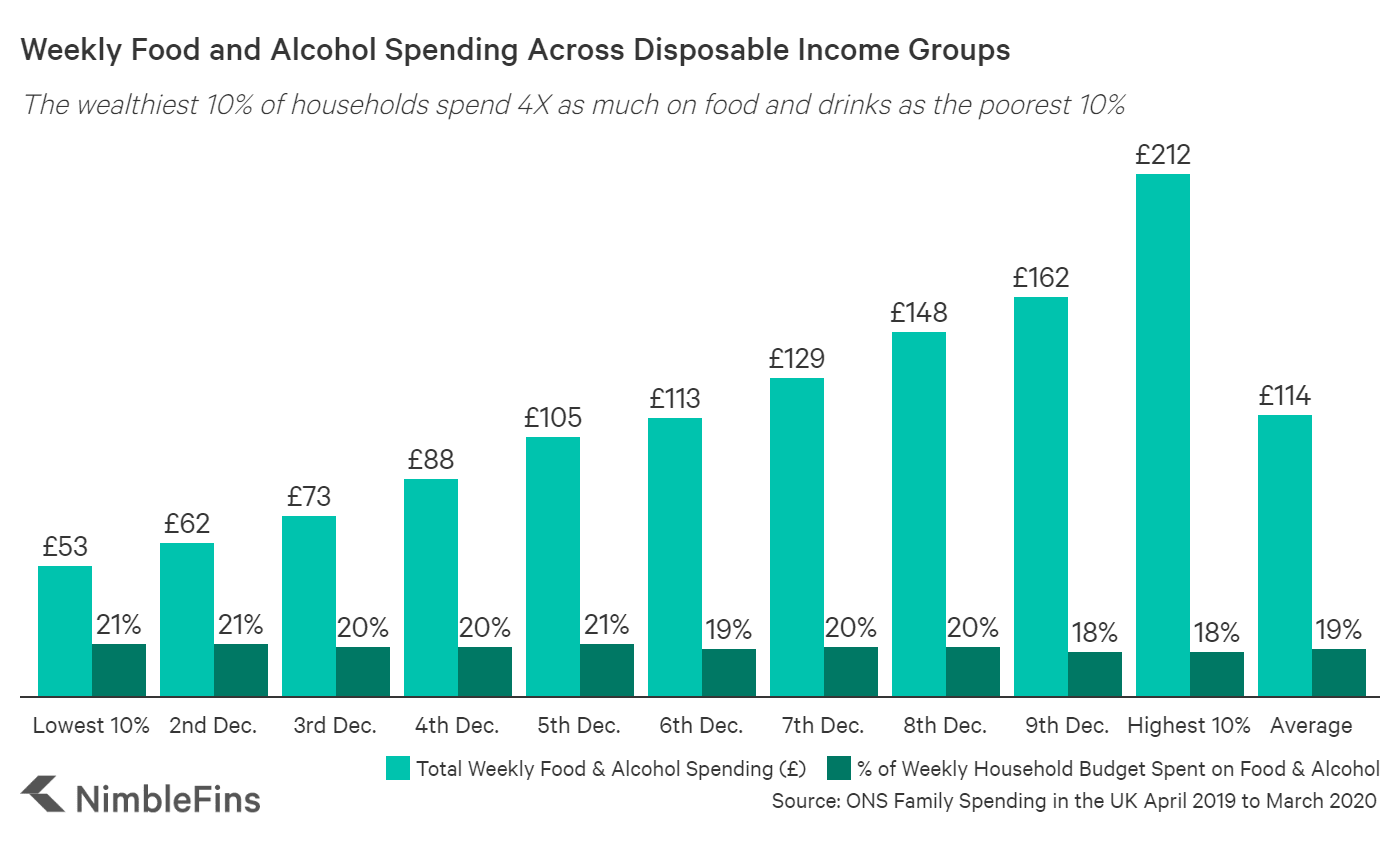
Weekly Food Budgets Increasing with Rising Incomes
Wealthier families spend a greater proportion of their total food and drink upkeep—44%—on food and beverage away from home, which includes restaurant meals and takeaways. Those on smaller budgets tend to salvage money by eating at habitation more, spending 75% of their nutrient and drink budgets for consumption at home and only 25% of their nutrient and drink budgets out at restaurants and on take aways.
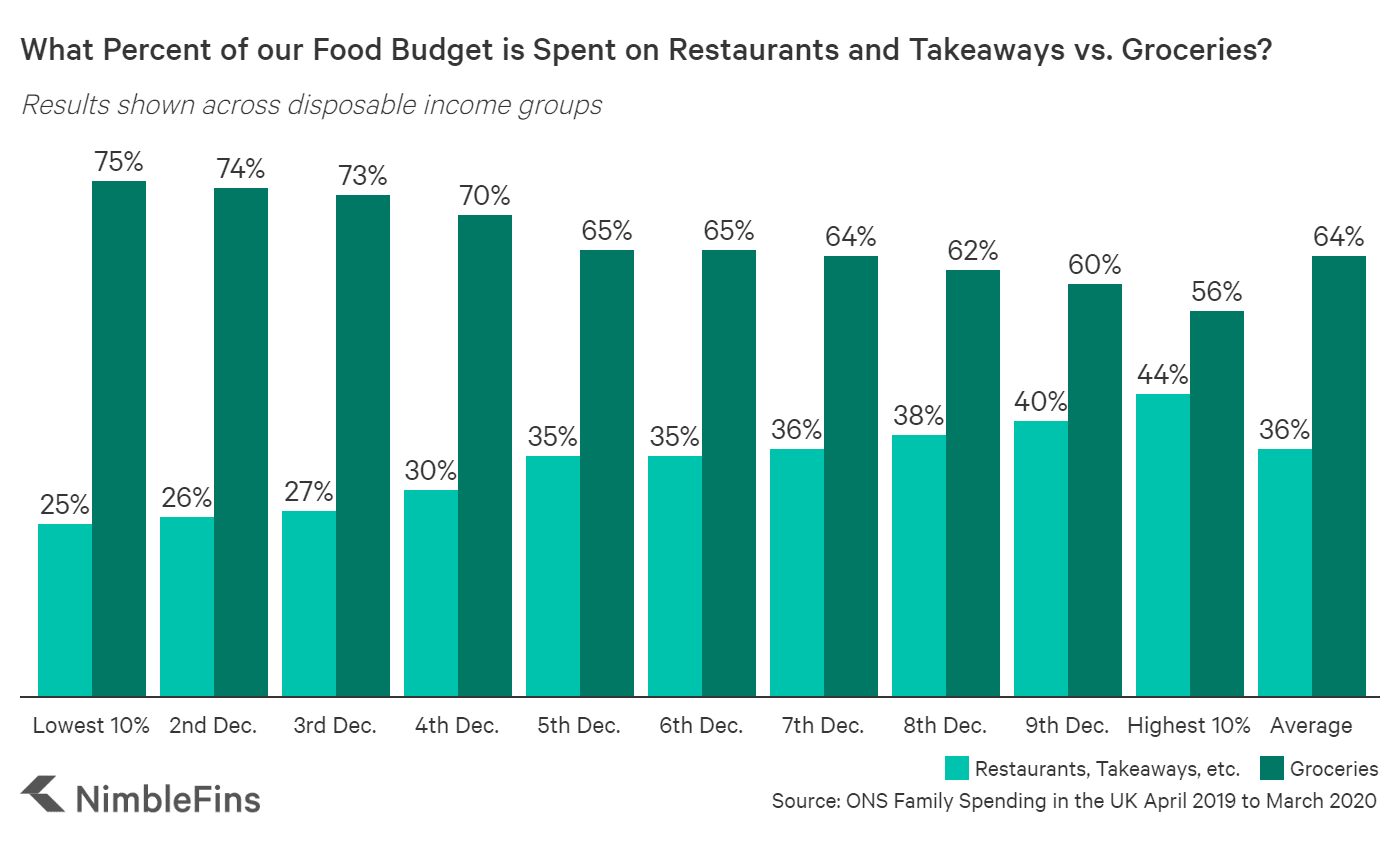
% of Food and Drink Budgets Spent Dining Out
In terms of actual spending, you can see how weekly food and drink budgets increment as disposable incomes ascent. The wealthier dine out more, the budget-constricted eat at home more.
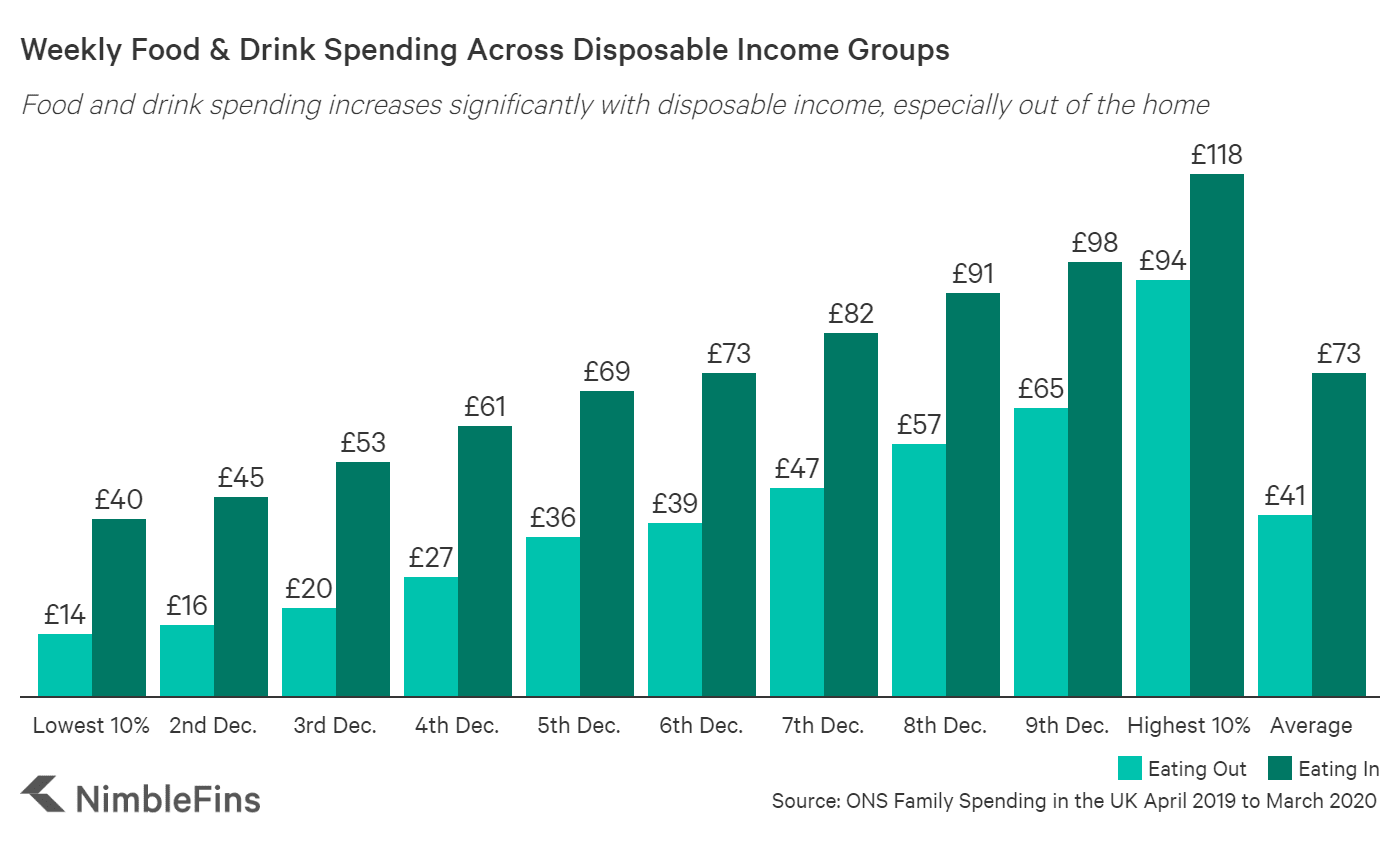
Average Weekly Food & Beverage Spending (at home and out) by Disposable Income Group
Shortcomings
To calculate nutrient costs per person and for different household sizes, we had to accept into account the unlike caloric needs of people of different ages and genders. For case, a young, active male person would burn around 3,200 worth of food a day while a typical 5-year-old kid would burn down just 1,400 a 24-hour interval. And the more nutrient you swallow, the more it costs yous.
To guess these figures, we first calculated the weighted average caloric needs of the Uk population, and divided the average spending for a household past the average number of people in a household (two.iv) to become a per (average) person nutrient budget. And so we tweaked this average 'per person' number to reflect the caloric needs of unlike ages and genders. We multiplied these per-person figures past the relevant caloric needs and added upwardly the people in a household to find the budget for different families. See beneath for an example of our calculations. Calorie demand figures were sourced here.
| Average caloric needs | Difference from average | Weekly food shop | Weekly cost of food prepared out | Boilerplate food costs per week | |
|---|---|---|---|---|---|
| Per Person | two,128 | 0% | £26.seven | £13.8 | £xl.42 |
| Adult Male person (age 16+) | 2,586 | 22% | £32.3 | £xvi.7 | £48.96 |
| Young, active male | iii,200 | 50% | £39.8 | £20.6 | £threescore.44 |
| Developed Female (Historic period 16+) | 1,971 | -7% | £24.vi | £12.7 | £37.33 |
| Young, active female | ii,400 | 13% | £thirty.i | £xv.5 | £45.58 |
| Child (ages 2 - 15) | 1,707 | -20% | £21.3 | £11.0 | £32.33 |
While this attempts to take into account different nutrient needs for family members of different ages and genders, please proceed in mind that these are estimates. And the calculations don't take into account savings that larger families tin can reach past buying in bulk, or that some families are a lot more than budget witting than others. If y'all have people in your family who consume less (e.g., a really small child) or are an efficient shopper who is careful with prices and takes advantage of sales or buying in bulk (e.1000., to feed a large family) then keep this in mind when comparison your ain spending to the figures presented here.
Inexpensive Eats: How to Salvage on Nutrient
Whatsoever your nutrient upkeep, you can probably borrow some tips from thrifty households to reduce costs down even further. Try to work these methods into your family's food programme.
1. Cook at habitation
It does take more fourth dimension, but cooking and eating at home tin can save loads of money over the long run. Consider that the bodily cost of food for a eatery meal is less than a third of what y'all pay for it. The residue of the coin you spend at a restaurant goes to other costs like labor and overhead. If y'all cook at home, you but pay the food cost, and pocket the rest. Team up with your partner, child or a friend to create great nutrient and memories.
2. Stock upwards on staples
Purchase big. Packages, that is. Stores usually charge less per unit (kg, litre, etc.) when you buy more at a time. This ways that a 2 kg bag of rice will price less per kilo than a 0.5 kg purse of rice. If you live near a warehouse store like Costco, consider condign a member. In that location yous'll have a meliorate chance of finding the largest food packages (due east.one thousand., American sizes).
3. Swap pricey proteins or appurtenances for cheaper ones
Ground beef costs less per pound than steaks. Chicken thighs price less than craven breasts (and are juicier!). Include lots of dried beans into your meals to add together protein and fill your family. Be on the await out for discounted nutrient that the grocery shop needs to sell that twenty-four hour period due to an impending expiration date—only exist certain to cook it ASAP!
Another way to reduce your food budget is by taking a look at your nonalcoholic beverages spend. The average United kingdom family spends a whopping 8% of their at-dwelling house food budget on coffee, tea, juices, mineral/sparkling water and sodas. While nosotros'd never advise eliminating your daily cuppa (coffee and tea aren't the upkeep problem anyway), there is really no room for soda, juice and fancy water in a tight budget. We accept two words for you: tap h2o.
If you don't like the taste of the life-saving liquid that flows plentifully from your tap, try squeezing in some lemon or humid it into tea. We try to keep a bullpen of bootleg iced herbal tea in the fridge—tastes great, cheap and has no carbohydrate or saccharide substitutes. Buying cappuccino at chains like Starbucks or Costa everyday, while user-friendly, tin easily full £one,000 a year, based on our calculations. Instant coffee with a dash of cinnamon or chocolate on top is an easy and impressive alternative.
Food and drinkable may be necessary for life, merely a few modest tweaks can help you spend less on them.
Food Budgeting
In addition to the steps above, if you're struggling with the budget it can be handy to take a deep dive into your current household spending. People are oft surprised when they run the numbers over a month and realise how much they spend on expensive food items like takeaways or coffee-shop coffee. For example, spending £twoscore on a weekly pizza takeaway, including soda and appetizers, adds up to over £2,000 a year! Popping a few frozen grocery shop pizzas in the oven volition toll less than half the price.
To understand your food spending you tin can sit down with pen and paper and get through your bank statements and credit carte bills once a month. Alternatively, there are a number of handy tech resources at our disposal these days.
For example, Money Dashboard is a personal finance app where you lot can easily view all your accounts and rail your spending past category—they have dissever pre-set categories including 'groceries' and 'nutrient & drinkable', which tracks money spent eating out. Money Dashboard is rated four.9 out of 5 stars by existing customers and is free to use. Budgeting apps like this (there are a number of them in the market) can be a nifty resource if y'all're watching your spending.
Comparison Food Spend to Other Areas of the Upkeep
While food is clearly a big upkeep item, there are a few categories that take an even larger bite of the average annual household budget. The boilerplate UK household also spends over £4,750 on transportation costs (including related insurance) and a whopping £10,600 on all things housing. Our largest utility cost is gas and electricity. The average UK household spent some other £1,360 per yr on gas and electricity in 2019. The toll to light, heat and run our homes accounts for close to v% of our household budgets each year.
If your household buys in majority to salve money and keeps a big store of food in the freezer, particularly expensive items like meat, yous might desire to check your home insurance policy to come across if freezer contents are covered. Policies that include freezer food will reimburse you up to a certain amount (due east.g., £one,000) if, for instance, you lose the contents of your freezer due to an electrical failure or your freezer breaking downward.
Note: Updated in March 2021 to reflect the most recent 2020 Living Costs and Food Survey from the ONS.
Sources:
Role of National Statistics Household size from the Office of National Statistics
Source: https://www.nimblefins.co.uk/average-uk-household-cost-food
0 Response to "Average Amount Family Spends on Meat Each Year"
Post a Comment